Stuck at the same revenue year after year?
This 5-minute Self-Assessment shows what's holding you flat: sales, pricing, crew capacity, supervisors, or you. 30 quick questions, built by Texas owner-operators who've run shops like yours.
Free. No email to see your result. No right answers. “I can't tell” is a fine answer.
See a sample result made-up answers

Rate what's really true in your shop today.
Most statements run from Not in place to Reliable. The sales-forecast question uses time ranges instead. Pick what's true today.
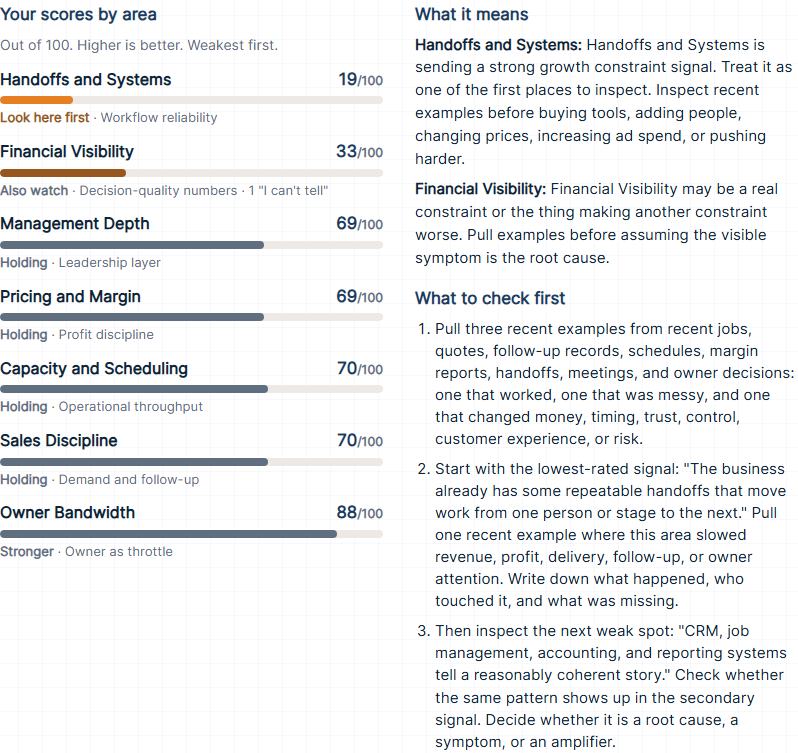
Where to look first
Take the full analysis with you.
The first result stays on this page without an email. The complete PDF gives you the working detail to use after you leave.
- Every score, with the two weakest areas explained in plain language.
- A three-step action sequence with a clear finish line.
- A printable scoresheet and notes page for the next conversation.
Find what's holding you flat before you fix the rest.
When revenue stalls, it's usually one or two problems making every other one louder. Find them before you spend money or push the crew harder.
Free first read: no sales call, and no email needed to see your result.
- Answer the questions.About 5 minutes. Your result shows on this page.
- See where to look first.The weakest spot in your shop, and one practical first move.
- Want the full report? Add your email.Only if you want every score, a closer look at your two weakest spots, and a three-step plan. Skip it and you still keep your result.
Built by owners who've sat in your seat.
We're Texas owner-operators, with the gray hair to prove it, who've run trade and industrial businesses. These are the questions we'd ask walking through your shop. It won't tell you everything. It will show you where to start: What's holding your revenue flat, and what's feeding it.
Skip this if it can't wait.
This self-assessment points you in a direction. If you're bleeding cash, losing key supervisors or skilled techs, or up against a deal deadline, skip it and talk to us instead.
Self-assessment FAQ
Why is my small business busy but not growing?
A business can be busy without becoming stronger if the work is running into a hidden constraint. Common causes include weak handoffs, poor scheduling visibility, underpriced work, margin leakage, owner dependency, limited management depth, or sales follow-up that happens only when someone remembers.
Read more about revenue plateaus
How do I know whether my revenue plateau is a sales problem or an operations problem?
Look at what breaks when more work shows up. If leads are missed, quotes sit too long, or follow-up depends on memory, sales discipline may be the constraint. If good sales create overtime, missed deadlines, rework, customer issues, or margin erosion, capacity and operations may be the constraint.
See what a review investigates
Should I spend more on marketing if revenue is flat?
Not until you know whether lead volume is the real constraint. More marketing can make things worse if the business already struggles with quoting, scheduling, pricing, delivery, or follow-up. First identify where the current flow of work is getting stuck.
Read the full answer
Should I hire more people to break through a revenue plateau?
Hiring can help when capacity is truly the constraint, but hiring before analyzing overtime, gross margin, scheduling, utilization, and management depth can add cost without fixing the bottleneck. The first question is whether more labor would create profitable throughput.
Learn how the review works
How can pricing and margin keep a business stuck at the same revenue level?
If pricing does not include full labor burden, overhead, risk, and required profit, the business may stay busy while profit and cash remain tight. Weak pricing can also make the company accept too much low-quality work, which consumes capacity that could be used for better customers or higher-margin services.
See the diagnostic areas
Why is financial visibility included as a growth constraint?
Because many small businesses are trying to fix growth problems with financial data that is not accurate enough to guide decisions. If QuickBooks, job costing, gross margin, customer profitability, or cash visibility is unreliable, the owner may not be able to see which work, customers, or constraints are actually hurting the business.
See how evidence is inspected
What does it mean if the owner is the bottleneck?
The owner is the bottleneck when routine pricing exceptions, customer issues, hiring decisions, people problems, scheduling conflicts, or approvals cannot move without the owner. The business may still function, but growth is capped by the owner’s attention and availability.
Review the Owner Bottleneck owner situation
Can AI or automation fix a revenue plateau?
AI and automation can help when they remove friction from a known constraint, such as lead follow-up, quote tracking, job documentation, reporting, CRM cleanup, or owner dashboards. They should not be the starting point if the business has not identified the real operating constraint.
Review the Practical AI owner situation
What score is good on the Revenue Plateau Self-Assessment?
The visible score is a capability score, so higher is better. Lower capability scores are not a failure; they are signals showing where the business may need closer inspection before investing in marketing, hiring, software, or a larger growth plan.
Start the self-assessment
Will someone call me after I take the self-assessment?
No. The first result appears on the page without an email. Enter your email only if you want the complete report with every score, detailed analysis, and the three-step action sequence.
See what the report includes
Is this a replacement for a Revenue Plateau Field Guide or Inspection?
No. The self-assessment report is the first decision aid: use it to name the likely pressure point and gather evidence. The Field Guide is for familiar, moderate-risk patterns where you want common causes, false fixes, and first tests. A Revenue Plateau Inspection is for tangled or higher-risk decisions that need a custom look at the actual numbers, workflows, people, systems, and owner decision patterns behind the score.
See the Revenue Plateau Field Guide
What happens after I complete the self-assessment?
You can view the first place to look without submitting contact information. If you want the complete PDF, enter an email at the bottom of the page. The report includes every score, a detailed read of your two weakest areas, and a three-step action sequence.
Email the complete report